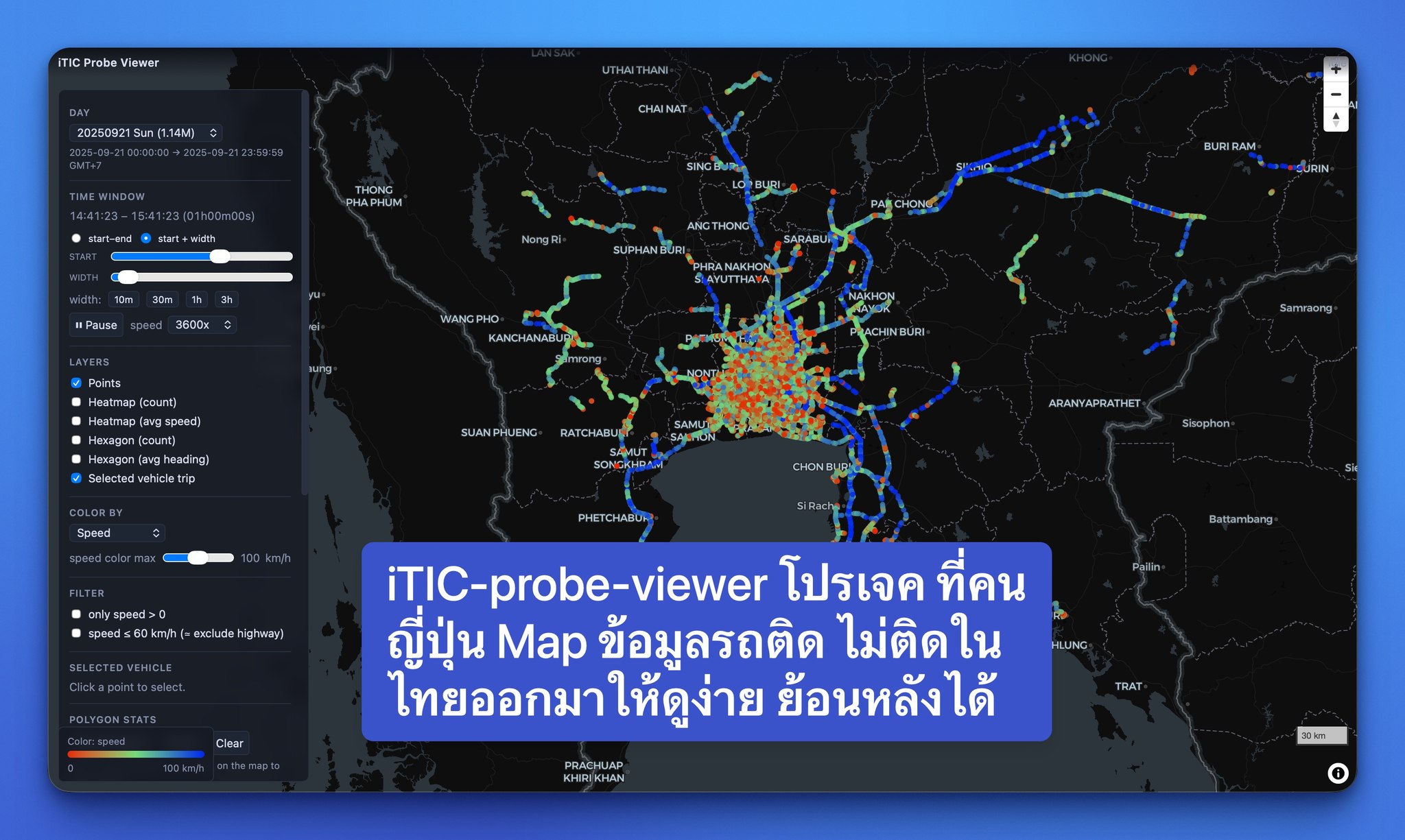
Beyond Static Maps: Unlike typical traffic maps that only show congestion levels, this Web GIS platform from Seo Lab (Tokyo Science) allows users to view the entire city’s movement in a time-lapse animation. You can explore heatmaps, individual vehicle trajectories, and the overall flow of traffic.
Understanding Urban Behavior: The viewer doesn’t just show that traffic is jammed; it reveals the behavior leading up to it—where cars start to slow down and how congestion accumulates. It’s like watching the city’s pulse in real-time.
Powered by iTIC Data: The platform is built on GPS probe data provided by the iTIC Foundation, featuring real records from taxis, trucks, and public transport. Every dot on the map represents an actual vehicle with precise coordinates, timestamps, and speeds.
Deep Analytical Capabilities: Users can draw polygons on the map to instantly see area-specific statistics, such as average speed or traffic density during rush hour, without needing to write a single line of code.
Data Accessibility: While the web version preloads specific dates for demonstration, the full historical data (released daily/monthly) is vast, reaching gigabyte levels. This allows for high-resolution analysis of urban movement patterns that static snapshots simply cannot capture.